
Key Account Systems
The structure behind growing key accounts in B2B needs changing

Growing key accounts takes more than records and tools. Explore the strategic layer account teams need and the nine standards behind the Vitality Index.
The structure behind growing key accounts in B2B needs changing
Last updated: October 7, 2026
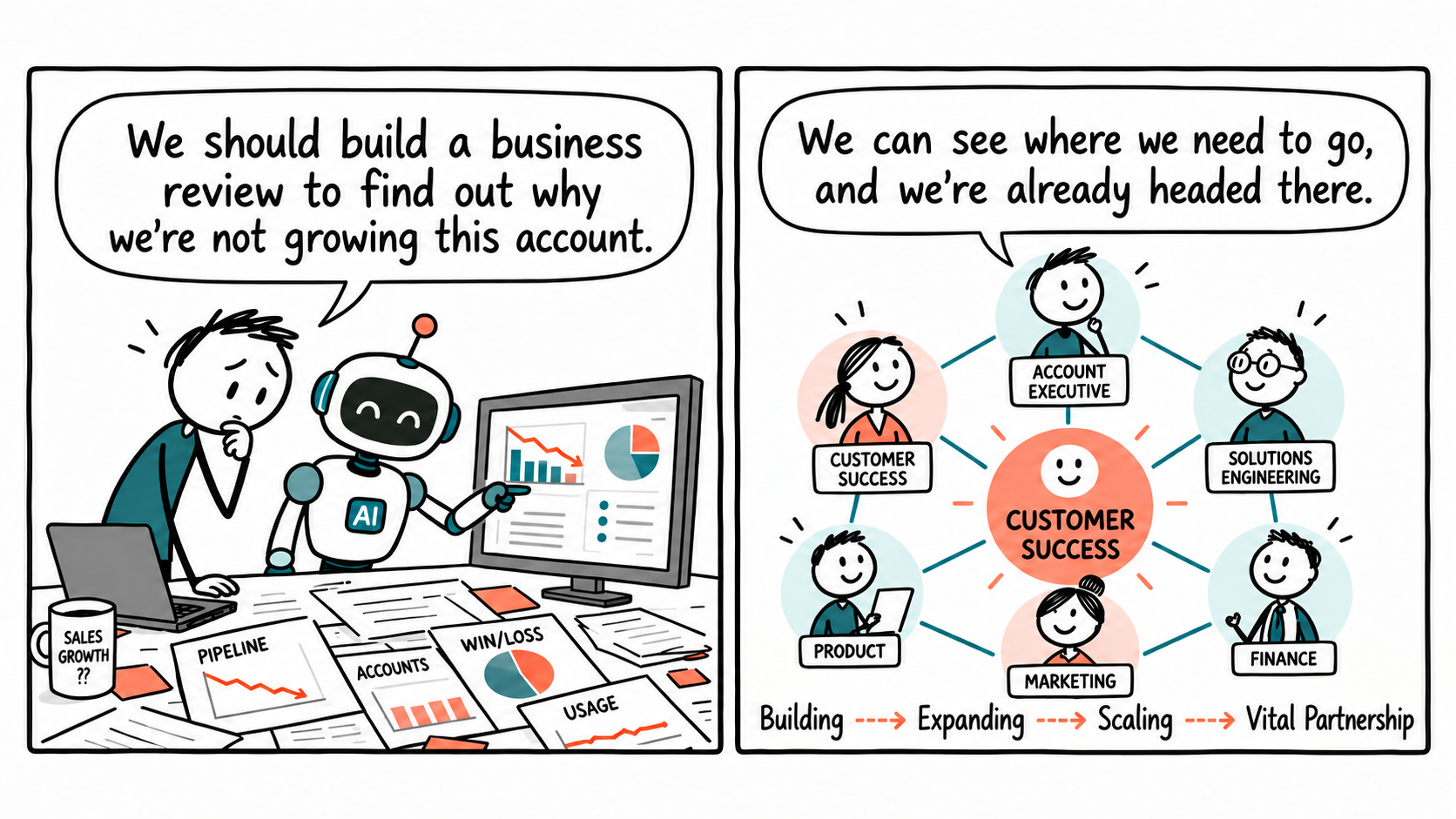
In our experience, most key account teams run on a structure built for managing sales activity: a CRM, account plans, QBR templates, and relationship maps. Growing key accounts takes a strategic layer those tools run on, one growth strategy the whole account team can see and execute, so the account keeps growing when people change.
What structure do most key account teams run on today?
A CRM, account planning, QBR templates, and AI relationship mapping make up a common tech stack for the sales motion. These tools help sellers work on their tasks more efficiently and keep better records. A growth system is the structure those tools run on.
I've talked to companies that have massive budgets for these tools but are missing the growth system, or as I call it, the strategic layer that everything runs on. You want these tools in your stack. They're just woefully incomplete for growing key accounts.
Research from the Strategic Account Management Association (SAMA) shows that strong strategic account programs deliver double the revenue growth for strategic accounts compared with non-strategic accounts.
Can a tenured, well-trained team replace a key account growth system?
A highly tenured team trained on advanced relationship management tactics is an asset. Without a system that provides the structure, rep dependency creates risk for your business when account managers leave or get promoted off the account. A good system can survive an account manager or other team members leaving. It can survive client contacts moving on or upward.
Like a GPS, it really doesn't matter who's driving as long as they're following the directions.
A friend of mine works for a large company and he's crushing goals every year, destroying the competition, and his clients love him. He wins and grows key accounts and has formed vital partnerships where he's become essential to the customer's success.
Here's the problem. If he leaves, no one at the company understands how he does what he does. He updates his CRM and keeps records of everything he does. But look at any of his tools or documentation and you won't see the future or the path forward, and you won't understand how the relationship functions. If he leaves, it's over: an $8M book of business built over 10 years, gone in 3 months.
Sadly, I've seen this play out hundreds of times in 30 years. Each time, the company was running the account on records alone, with no growth system to hand the next person.
Does every industry need its own structure for growing key accounts?
That's what the B2B consultants would have you believe. A good system is industry-agnostic because it's based on structures that are true for anyone trying to grow a key account relationship. The system follows how key account relationships already work.
No need for secret sauces that don't scale anyway. No need for custom builds when you have the right structure in place. If you look closely enough at this like we have, you see the patterns that show up repeatedly across B2B industries.
I've watched the same patterns in staffing, aviation, energy, education, IT, consulting, manufacturing, healthcare, and biotech. Across all of them, the same patterns grew vital partnerships. It took one structure: the one that maps the domains holding the keys to growth.
What should a key account growth structure include?
The new structure is built from the patterns that run underneath key account relationships, across company sizes, industries, talent levels, and tool stacks. Because those patterns exist, they can be mapped. The Vitality Index maps them across 4 levels of partnership and 21 Growth Drivers inside the 7 Partnership Domains, then shows the account team the next moves and plays to advance the relationship.
In my experience, most teams rarely build this structure for themselves. When they do, it changes as a reaction when something stops working. We built the Vitality Index to give B2B teams a structure that shows the end from the beginning and holds steady while the people and the market move.
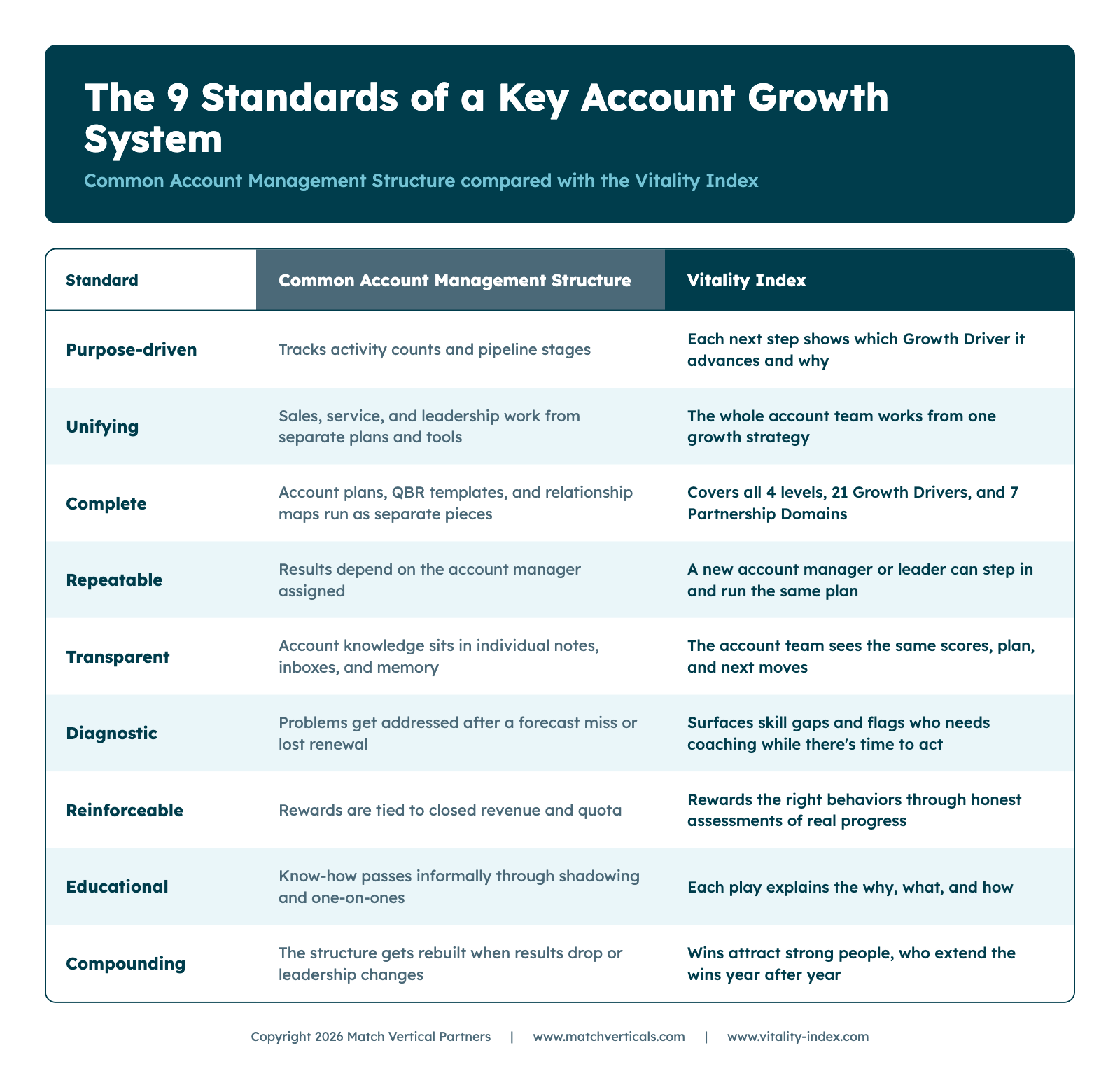
We held it to nine standards. Here's how they compare with a common account management structure.
Frequently asked questions
Do we have to replace our CRM?
No. The Vitality Index runs alongside your CRM and the rest of your tech stack. Your tools keep the records, and the Vitality Index gives the account team the growth strategy those tools run on.
Who on the account team runs the growth system?
The whole account team works from the same growth strategy. The frontline manager uses it to coach, calling the next plays for each account manager based on where their account scored.
Have a key account you want to grow? Book a 15-minute consultation.
More in Key Account Systems
Key Account Systems
The 7 Partnership Domains of any Key Account Relationship
Think of a key account relationship as a house with seven rooms. Each Partnership Domain has three Growth Drivers, and the Vitality Index shows teams what to do next to grow and protect the whole partnership.
Key Account Systems
The boss wants a better growth strategy for your key accounts this quarter.
Salespeople are hired to grow key accounts, not rebuild a complex growth strategy from scratch every quarter. Here's why a system for assessment, strategy, and execution gives them more time to sell.
Key Account Systems
Ask your reps one question: what are you doing today, and why?
There is one question that audits a sales organization faster than any dashboard: what are you doing today, and why? Ask it on any sales floor and you will hear the same answers. Hit my activity goals. Hit my target. Grow the business. Every answer is motion or a scoreboard. Almost none is an aim. Here is how to read the answers, and what they reveal about whether your team is running a system or just trying to keep moving.
Key Account Systems
Why your sales training fails to produce ROI
The best sales methodologies are genuinely great. And under pressure, in front of a live customer, most reps forget all of it and go with their nature. Aviation, the military, medicine, and elite sports all solved this exact problem, and none of them solved it with more courses. They embedded the training in a system that delivers it under pressure. Here is the evidence, and what it means for your next training investment.
Key Account Systems
9 reasons your CRM is costing you sales
Ask most sales teams if they have a system and they point at the stack. But a CRM records what happened, while a real system tells every rep what to think and why, what to do, and how to do it. Here are the nine standards that separate the two, and why the difference is costing you sales.
Related across the blog
Strategy & Planning
Your customer account plans are missing some vital pieces
Account plans go stale because they are snapshots, written in a planning event while the account keeps moving. Reps stop using them because nothing in the daily work ever touches the plan again. Both problems have the same cause: the plan is missing vital pieces. Here are the pieces, and how to put them in.
Key Account Growth
You just won a massive key account. Now what?
Winning a massive key account is only the start. The real work is building a partnership that can withstand renewals, competitive threats, and growth across the business.
Coaching & Leadership
Almost every best-selling sales book teaches your reps how to win the deal. Few, if any, teach you how to coach them on what comes after.
Sales books teach reps how to win deals, but leaders still need a shared standard for coaching the retention, expansion, and protection of key accounts.
Lead with better systems.
The same frameworks that power this post power Vitality Index - the platform strategic account teams use to measure, plan, and grow their most vital partnerships.