
Sales Leader Insights
The final quarter of 2026 is fast approaching. How well is your key account strategy holding up?

The CRM is updated and the QBR deck is ready, but does the account plan actually show how your key accounts will grow? A look at the planning burden behind Q4 forecasts and a system designed to lift it.
The final quarter of 2026 is fast approaching. How well is your key account strategy holding up?
Last updated: September 23, 2026
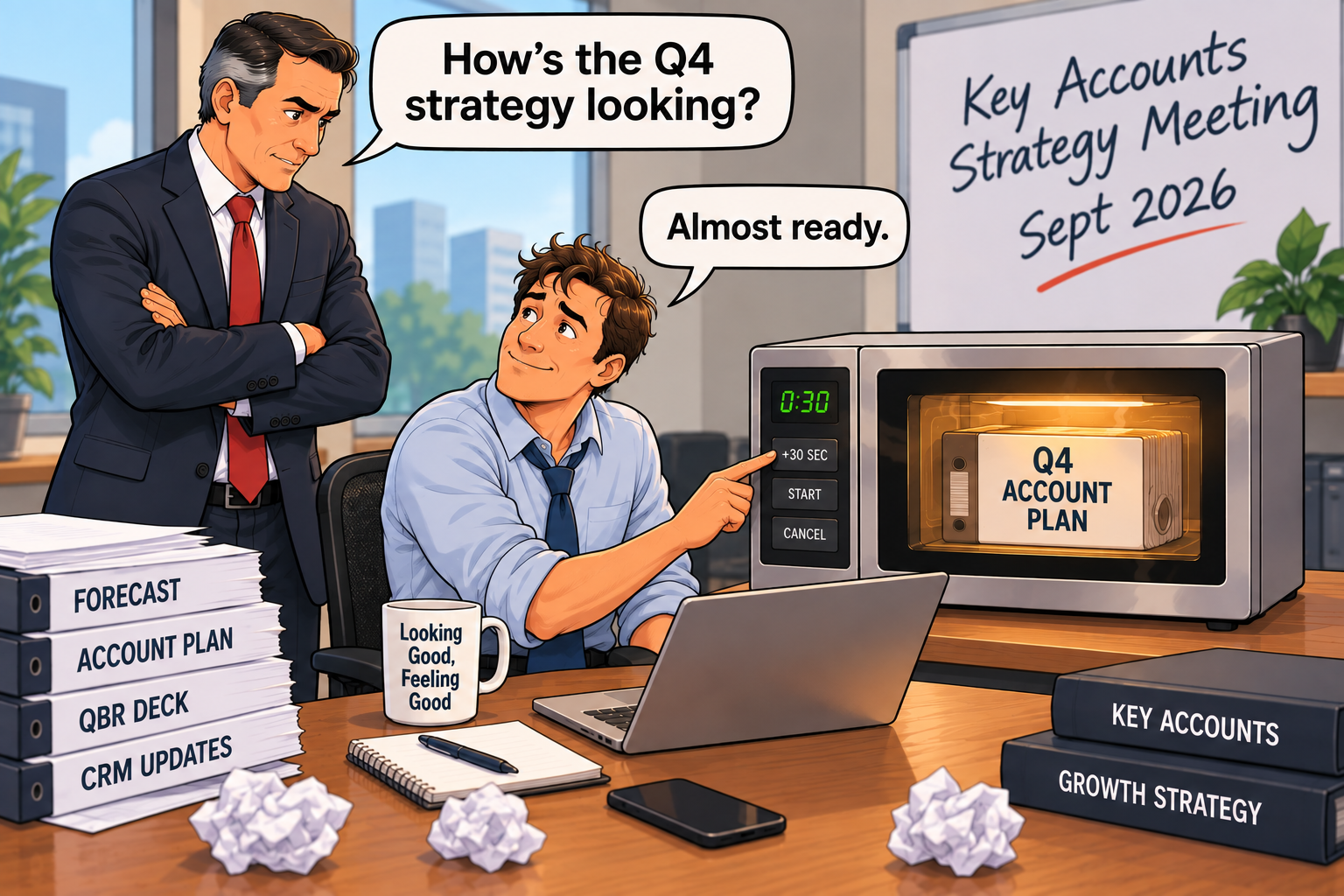
By now, you most likely know if you are going to hit your forecast numbers for 2026. If any one of your key accounts has gone backwards, leadership will call you into a meeting. It's not a strategy review. It's a performance evaluation on your ability to run an accurate forecast.
The CRM looks updated. The QBR deck is assembled. The staging looks current. We all know how this has to be built, on an impossible deadline, two days before the review, between calls, between meetings, over the weekend. The minimum viable effort to survive the conversation with leadership.
That's not a criticism. That's human nature. Salespeople are rewarded for selling, not for strategy building and account planning. The planning happens in the margins, the last 48 hours before the deadline. It's always been that way. It will always be that way. No training, no coaching, no CRM enforcement is going to change that. And anyone who has managed people for more than a year knows it.
The reality is most of what goes into forecasting is guesswork. The account plan looks detailed in the CRM. The client org charts and mapping are correct. The sales staging activity looks current. These inputs confirm you've done the administrative work. They say nothing about whether the account is going to grow or not.
Most teams are never going to build a comprehensive growth strategy for every key account without being told to do so, which now makes it a task versus a mission. Not because they're incapable. Because the work required to do it well across 10, 20, 30 accounts is, in some cases, more than any human can produce in a planning cycle.
The assessment alone takes days per account if done thoroughly. The competitive analysis, the relationship mapping, the gap identification, the play selection, the execution planning, the team coordination. That's weeks of work per account. Multiply that by a portfolio and you're looking at a full-time job that nobody was hired to do. What's worse, if that work isn't constantly happening throughout the quarter, then it's too late to do it now. Your key account growth strategy was never meant to be an assignment, but an ongoing endeavor that is worked every single day.
So what happens? The top five accounts get attention. The other 25 get a recycled plan from last quarter with updated dates. Leadership gets a forecast built on guesswork, and 78% of sellers miss quota (Ebsta x Pavilion, 2025 GTM Benchmarks Report). The research shows that 61% of revenue comes from existing accounts, and 20% of those customers generate 60-80% of that revenue. The accounts carrying the business are the ones that require more strategy and planning.
But who has the time?
No one, at least not if they want it done the right way. So, we stopped trying to change this behavior and built a system that doesn't depend on conformity. If your team can follow a playbook, they can execute in this system.
The Vitality Index already did the work your team was never going to do. The assessment, the scoring, the growth strategy, the plays, the execution plan. It's done before Q4 planning even starts. Your team can keep being exactly who they are.
The procrastinator who scrambles the week before the review now has a tailored growth strategy ready to present. The rep who does the bare minimum on the account plan now has 1,200 plays mapped to their specific partnership level. The manager who dreads the forecast conversation now has evidence to walk in with. The account that's been sitting flat for three years because few had time to do this work the right way.
We didn't build the Vitality Index to make your team work harder. We built it so they don't have to.
The Vitality Index is the only system in the marketplace that creates your growth strategy and execution plan for you. No data migrations necessary because the science behind the system is what produces the growth strategy. You can sync your calendar to update your CRM and see your activity and schedule fill up across your entire account team, across all domains and functions, running the right plays at the right time so you can advance your key accounts consistently.
Everything that can be known about growing a key account is in the Vitality Index waiting for you to log in for access. We designed it from actual experience and case studies that took 30 years to build and generated over $2B in key account revenues.
It's a complete, end-to-end system that takes your account through 4 partnership levels ending in Vital Partnerships, an account team your client won't live without. We organized the assessment, scoring and strategy to follow the same framework. Once you're in, you will see over 1,200 handcrafted plays your account team will run until you reach Vital Partnership. The Vitality Index decoded 30+ years of industry-leading success so teams can just run the system and focus their time on growing the business.
The strategy part is done. Your job is just to run it to perfection.
Try our Free Sample. Assess one account across two of seven Partnership Domains. See your growth strategy in minutes.
More in Sales Leader Insights
Sales Leader Insights
In B2B sales, the top 1% have this in common
The top 1% of B2B sellers share a deep belief in the value they create. That conviction comes from customer knowledge, competitive insight, executive support, and a system.
Sales Leader Insights
Honey bees don't need pipeline reviews to hit their honey quota
A hive of 50,000 bees coordinates one of the most complex operations in nature with no meetings, no dashboards, and no manager checking whether anyone is active. The work itself tells every bee what to do next. Most sales teams run the opposite way: layers of management monitoring CRM dashboards, inspecting activity, and coaching from a playbook written for conditions that no longer exist. Here is what sales management looks like when the system carries the coordination.
Sales Leader Insights
Why hiring more veteran producers won't fix your revenue concentration problem
A sales leader we work with has one rep who crushes forecast every year and 26 others who fall well short. He believes the top rep just has it. That belief is the most expensive one a sales leader can hold, and it is the reason revenue concentration keeps getting worse despite 25 years of hiring, training, and tooling. The fix is not more veterans. It is a system that makes what top producers do visible, transferable, and repeatable across the whole team.
Sales Leader Insights
How a Sales Leader can still hit forecast without relying on their top salespeople?
A sales organization's success should not rest on a few top performers. When the top 14% of your reps produce 80% of your revenue, the exposure is that the selling capability lives inside a few people, not inside the system. A sales leader hits forecast by building the system that carries a top producer's performance across the whole team, so the number survives a resignation, a promotion, or a bad season.
Sales Leader Insights
Breaking the Revenue Ceiling: Why Mid-Market Companies Build a Key-Account Sales Organization Before the Next Stage
Before spending on enterprise reps and new tools, confirm the upside is real, avoid the costly early moves, and follow the order the companies that break through tend to use: build, scale, invest, protect.
Sales Leader Insights
Research Says CROs Miss Forecast by More Than 10%, Nearly 80% of the Time. Here's What Keeps That From Being Your Story.
Nearly 80% of sales organizations miss their forecast by more than 10%. The research shows where the more predictable number actually lives, and three shifts that change the outcome.
Related across the blog
Strategy & Planning
Your customer account plans are missing some vital pieces
Account plans go stale because they are snapshots, written in a planning event while the account keeps moving. Reps stop using them because nothing in the daily work ever touches the plan again. Both problems have the same cause: the plan is missing vital pieces. Here are the pieces, and how to put them in.
Key Account Systems
The structure behind growing key accounts in B2B needs changing
Growing key accounts takes more than records and tools. Explore the strategic layer account teams need and the nine standards behind the Vitality Index.
Key Account Growth
You just won a massive key account. Now what?
Winning a massive key account is only the start. The real work is building a partnership that can withstand renewals, competitive threats, and growth across the business.
Lead with better systems.
The same frameworks that power this post power Vitality Index - the platform strategic account teams use to measure, plan, and grow their most vital partnerships.